
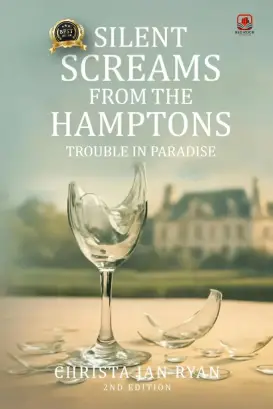
The Hamptons is a place defined by its aesthetic. From the crisp white linens and nautical blues of its fashion to the perfectly manicured privet hedges that guard its estates, “Hamptons Style” is more than a wardrobe—it is a social armor. It represents a level of achievement and serenity that most only dream of. However, beneath the starched collars and designer sunglasses, there often lies a narrative that the glossy magazines never capture.
In the realm of Addiction recovery memoirs, there is a new and vital entry that challenges the polished facade of Long Island’s South Shore.
Christa Jan Ryan’s book, Silent Screams from the Hamptons, serves as a visceral reminder that trauma does not care about your zip code. It explores the intersection of high-society expectations and the soul-crushing weight of inherited pain, positioning itself as a standout among Breaking generational trauma books.
The Fabric of a Facade: Clothing as a Shield
In the Hamptons, clothing serves a functional purpose: it signals belonging. To walk down Main Street in East Hampton is to participate in a silent parade of status. But for those living within dysfunctional cycles, these clothes are often a “costume of normalcy.”
Christa Jan Ryan’s story highlights this duality perfectly. As a successful landscape designer for over three decades, she was responsible for creating the “look” of the Hamptons. While she was selecting the perfect perennials for multi-million dollar estates, she was personally draped in the attire of the successful professional. Yet, as she reveals in Silent Screams from the Hamptons, that attire was often hiding a heart racing with anxiety and a mind clouded by the “neurotoxic” effects of addiction.
This is a common theme in the most impactful Addiction recovery memoirs. The protagonist often describes the exhaustion of maintaining a high-functioning exterior. The “Hamptons Style”—elegant, breezy, and effortless—becomes a heavy burden when one is drowning internally. It is the ultimate irony: wearing the finest fabrics while feeling completely threadbare inside.
Breaking the Pattern: The Call of the Memoir
Why do we turn to Breaking generational trauma books? It is because we are looking for a mirror. We want to see if someone else has survived the same “soundtrack” of chaos that played in our own childhood homes.
In Silent Screams from the Hamptons, Ryan describes a childhood that was a “chaotic dysfunctional” landscape. Her parents, high-profile figures who met after WWII, created a family of six children in just seven years. With three children suffering from Cerebral Palsy and parents who used domestic violence and alcohol as coping tools, Christa was the “forgotten child.”
Her memoir joins the ranks of essential Addiction recovery memoirs because it doesn’t just focus on the “what” of her addiction, but the “why.” She explains how the patterns of her parents—the “make-up sex,” the volatility, and the substance abuse—became the blueprint for her own adult life. This is the definition of generational trauma: a baton of pain passed from one hand to the next until someone finally has the courage to drop it.
The High Cost of the “Polished Mask”
There is a specific type of suffering that occurs when one’s environment demands perfection. In the Hamptons, where every home is a showcase and every outfit is an investment, the pressure to “keep up” is immense.
For Ryan, this meant navigating the “Fabulous Hamptons” while raising two sons and struggling with the same destructive cycles her parents modeled. The book Silent Screams from the Hamptons details how trauma can wear a very polished mask. It explores the cognitive dissonance of being a “successful” designer whose internal world was collapsing.
When we look at Breaking generational trauma books, we often see authors who had to lose everything before they could find themselves. Christa’s turning point came at her mother’s deathbed. Seeing the “soundtrack” of her mother’s life repeating in her own, she realized that the Hamptons lifestyle, the career, and the outward “style” meant nothing if she was losing her soul.
Recovery as the Ultimate Transformation
True recovery is a complete re-styling of one’s life. It isn’t just about removing a substance; it’s about changing the very fabric of one’s being. Ryan’s journey, as chronicled in Silent Screams from the Hamptons, is an “extraordinary comeback” fueled by a return to faith.
In many Addiction recovery memoirs, the “higher power” is a central theme. For Ryan, finding empowerment through God allowed her to step away from the toxic relationships and “trauma bonding” that had defined her existence. She traded the “silent screams” of her past for a voice that now speaks truth to others.
This spiritual transformation is what makes her work one of the most compelling Breaking generational trauma books available today. She shows that you can’t just put a “new outfit” on an old problem. You have to go deep into the roots—much like the landscapes she designed—and pull out the rot to allow new life to grow.
The Semantic Shift: From Victim to Survivor
The language we use to describe our pain changes as we heal. In the beginning, there are only “silent screams.” By the end of Ryan’s memoir, there is a clear, resonant message of hope.
Her book, Silent Screams from the Hamptons, contributes to the genre of Addiction recovery memoirs by proving that recovery is possible even when the odds are stacked against you from birth. It serves as a guide for:
- Bereaved Parents: Offering comfort through her own experiences of loss.
- Addicts in Hiding: Showing that professional success doesn’t mean you don’t need help.
- Victims of Domestic Violence: Providing the “courage to relive the nightmare” in order to escape it.
Conclusion: A New Aesthetic of Healing
“Hamptons Style” will always be associated with luxury, but thanks to the Christa Jan Ryan memoir, we might also begin to associate the region with a different kind of strength: the strength to be honest.
Silent Screams from the Hamptons stands as a powerful testament in the world of Breaking generational trauma books. It reminds us that the most beautiful thing we can wear is our own truth. Ryan’s story encourages us to look past the designer labels and the manicured lawns to see the human being underneath—the one who has fought through the addiction, survived the trauma, and emerged not just “better,” but free.
As the genre of Addiction recovery memoirs continues to grow, voices like Christa Jan Ryan’s are essential. They remind us that no matter how loud the silence has been, it is never too late to start speaking. The cycle ends when we decide to stop performing and start living. For Ryan, that meant stepping out from the shadows of the Hamptons elite and into the light of her own extraordinary recovery.